21 Things AI Could Do at Our Nonprofit. Here Is What We Built.
A real list from a real audit, including the items still sitting there.
- How to Tell If the Answer AI Just Gave You Is Any Good
- We Wrote an AI Policy for a Real Nonprofit. Here It Is.
- 21 Things AI Could Do at Our Nonprofit. Here Is What We Built. (you are here)
- The AI Worked. We Were Not Ready For It.
Search for what AI can do for a nonprofit and you will find a list of capabilities written by somebody who sells software. This is the list from a real audit at a real housing nonprofit, including the four items we haven’t yet managed to build.
I run operations at Habitat for Humanity of Michigan, a state office supporting 43 local Habitat affiliates. A couple of months ago I ran an AI audit across our own organization, which meant sitting down with people across five programs and asking each of them to walk me through their real work. I wanted the day-to-day version rather than the job-description version, including the parts everybody knows are redundant and nobody has time to fix.
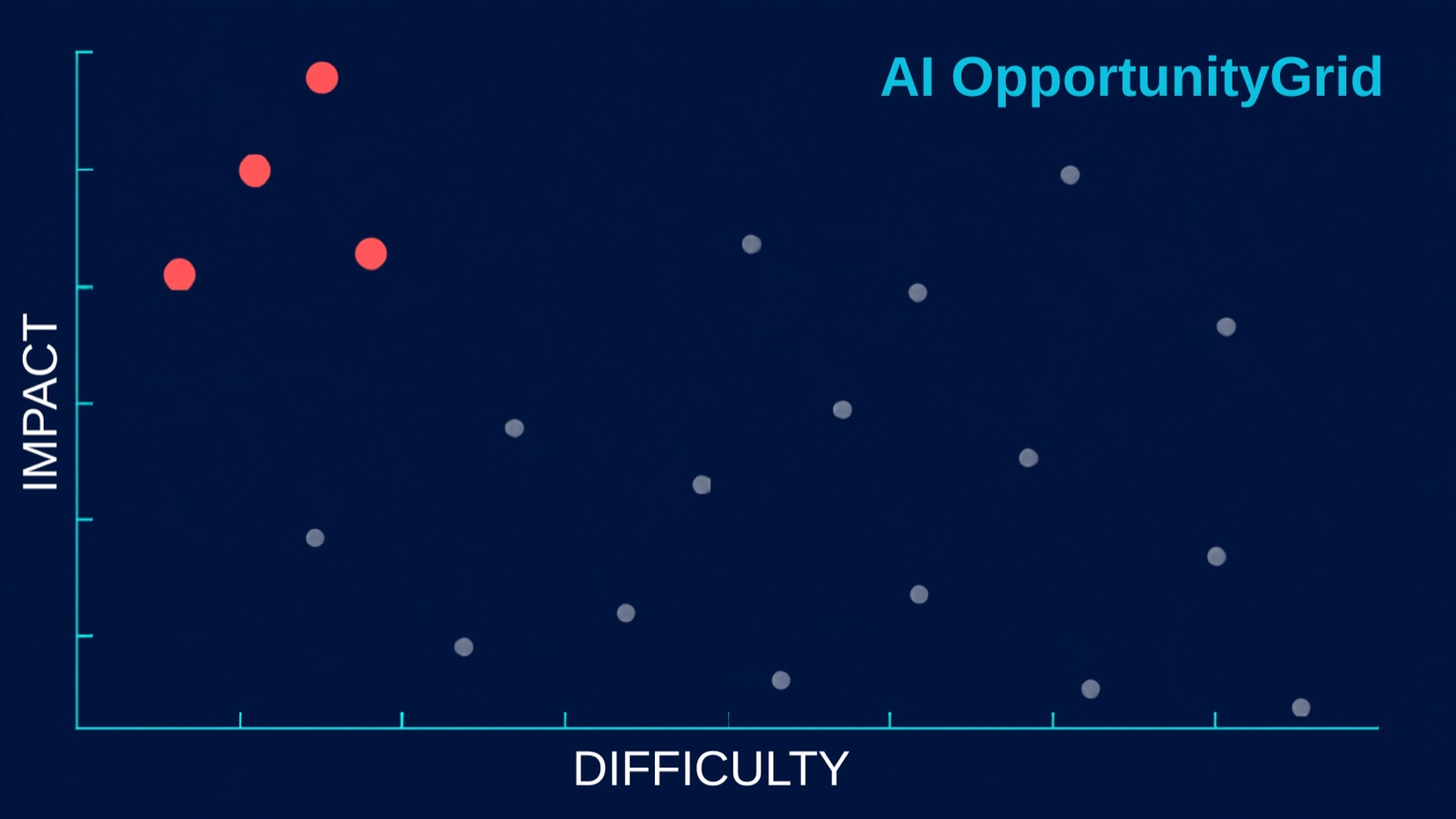
Twenty-one opportunities came out of those conversations. Each was scored twice, once for how much it would help and once for how hard it would be to build.
The shape of the list
- High impact, low difficulty: 4
- High impact, medium difficulty: 4
- High impact, high difficulty: 4
- Medium impact, medium difficulty: 7
- Medium impact, low difficulty: 2
Twelve of the 21 are rated high impact. Only four of those twelve are also low difficulty.
I paid attention to the impact score for weeks. The difficulty score turned out to matter more, and this piece is mostly about why.
The easy end
The four that are high impact and low difficulty are almost boring to read.
- A searchable home for our written procedures, so people stop asking the same three colleagues the same questions about lien removal and HUD system steps.
- Meeting recordings turned into task lists and follow-up drafts.
- Reply drafts for the client emails we answer forty times a month.
- Triage on a shared inbox so the urgent items surface above the routine ones.
None of that will impress anyone at a conference. All of it can be running relatively quickly, set up by the person who actually has the problem.
The hard end
The four at the other end…
- One client record that holds together across four systems that do not currently talk to each other.
- A documentation setup for our housing counselors, who spend thirty to forty-five minutes writing up every appointment and enter a good deal of it in two places.
- Automated compliance checking on the hardest ten percent of our closings, which is where nearly all of the pain in that program lives.
- Electronic intake forms, so nobody has to retype a PDF into a spreadsheet ever again.
Those four are still untouched.
They are untouched for reasons that have nothing to do with the quality of AI. Every one needs systems connected to each other, data cleaned up first, and money approved by somebody who has to say no to something else to fund it. Those are the constraints, and better prompting does not move any of them.
Impact tells you what to want, difficulty tells you what you can finish
If your organization has a technology department, sorting your list by impact is a perfectly sensible thing to do, because you employ people whose entire job is turning hard things into shipped things.
Many nonprofits are not in that position. If you have between five and fifty staff and nobody whose job title contains the word technology, sorting by impact puts everything you cannot complete at the top of your list. You will spend your first three months there, complete nothing, and reasonably conclude that this was all overstated.
That conclusion is wrong, and the experience that produced it is completely real. This is the failure mode I would most like to spare you.
So we re-sorted by difficulty and worked from the easy end.
What got built
Grant research. Before anyone writes a word of an application, the AI reads the funder’s guidelines, eligibility rules, exclusions, and FAQ. Those are the pages nobody has time for, and they are where all the disqualifying information lives.
Run this month across four different funding needs at once, it produced three applications genuinely worth starting, one renewal conversation that matters more than the three of them together, and about a dozen phone calls that need making.
The most useful thing it returned was a rule rather than a funder. Check the funder’s geography and their charter before you look at program fit, because a perfect program match at a funder who only gives inside one county is still a rejection.
That rule now lives in the file the workflow reads every time it runs, which means I get the benefit of having learned it without having to remember it.
Client content and communications. Less interesting to write about and more consistent in practice. Content production runs about five to six hours a month lighter than it did. It is a real number and it repeats every month.
Neither of those scaled until two unexciting things existed.
We needed a written data policy, so staff knew what they were permitted to put into the tool and what they were not. And we needed training, which became seven short recorded videos and a small first group working through them together, with our CEO in that group rather than watching from the sidelines.
Neither of those is an AI feature. Both had to exist before any of the AI mattered. Between them they consumed more of my time than every workflow on this list put together, and if I were doing it again I would budget for that from the start.
Do this at your own organization
Ask four or five people to walk you through a normal day. Write down every point where somebody moves information by hand from one place to another, retypes something that already exists somewhere, or compiles a document out of pieces. That is your list.
Then score each item twice.
One: if this were fixed, how much would it help? High or medium is enough precision. You are ranking, not measuring.
Two: what would it take to build? Be hard on yourself here. If your honest answer contains the phrase “we would need IT to,” or “first we would have to clean up,” or “that depends on the budget,” it is not a low-difficulty item no matter how simple it sounds when you say it out loud.
Want a map of how the work moves across your organization?
Book a free call about an AI Strategy Audit.
Book a free 30-minute call