The AI Opportunity in Your Nonprofit Is Hiding in the Copy-Paste
I spent a month interviewing my own team about their real work. Here is where AI actually belongs, and it is not where I expected.
This spring I did something I had wanted to do for a long time. I sat down with people across five different programs inside the nonprofit where I run operations and asked each of them to walk me through their actual work. Not the version that lives in a policy manual. The real version, the one with the sticky notes and the workarounds and the “and then I just do this part by hand every time.”
I went in expecting to come out with a shopping list of software. What I came out with instead was a much clearer picture of where AI actually belongs in a nonprofit, and it was not where I would have guessed a year ago.
The pattern I did not expect
One of the first conversations was with a coordinator who manages client cases. She walked me through what happens when she closes out a file. She has to take documents that arrived in three or four different formats, a Word file here, a photo of a signed form there, a PDF from another system, and turn all of it into a single clean packet to submit. She does this by hand, one file at a time, for every client who closes. It is careful, important work, and almost none of it requires her judgment. It just requires her time.
I heard a version of that same story in every program. A counselor drafting detailed case notes in one document and then copying them, line by line, into the system of record because the upload never displays cleanly. Reminder emails sent out by hand before every class, with the same attachments every time. A grant program tracked across a spreadsheet, an inbox, and a shared drive, with one person holding the whole picture in her head.
None of these are technology problems in the way we usually mean it. Every one of these teams already has software. The pain was not living inside the tools. It was living in the seams between them, in the manual handoffs and the copy-paste and the work that gets done by hand simply because no one ever had time to change how it flows.
The person who had already figured it out
The most useful thing I learned came from the one coordinator who was already using AI well, and it is worth sitting with, because she is not what most people picture when they imagine an early adopter.
She does not write code. She has no technical background and no interest in acquiring one. What she has is a clear sense of her own work and the willingness to describe it plainly. She started using an AI note-taker for her client calls because she was tired of splitting her attention between listening and writing, and she wanted concise summaries and a checklist she could act on afterward. She started using a dictation tool that turns speech into clean text because typing up notes at the end of a long day was costing her hours she did not have.
She adopted these tools not because someone rolled them out to her, and not because she is technical. She adopted them because she could look at a specific, repeating part of her week, describe exactly what she wished were different, and hand that description to a tool that could help. That is the whole skill. It is not a technical skill at all. It is the ability to see your own work clearly and say what you need out loud.
What this changed about how I think
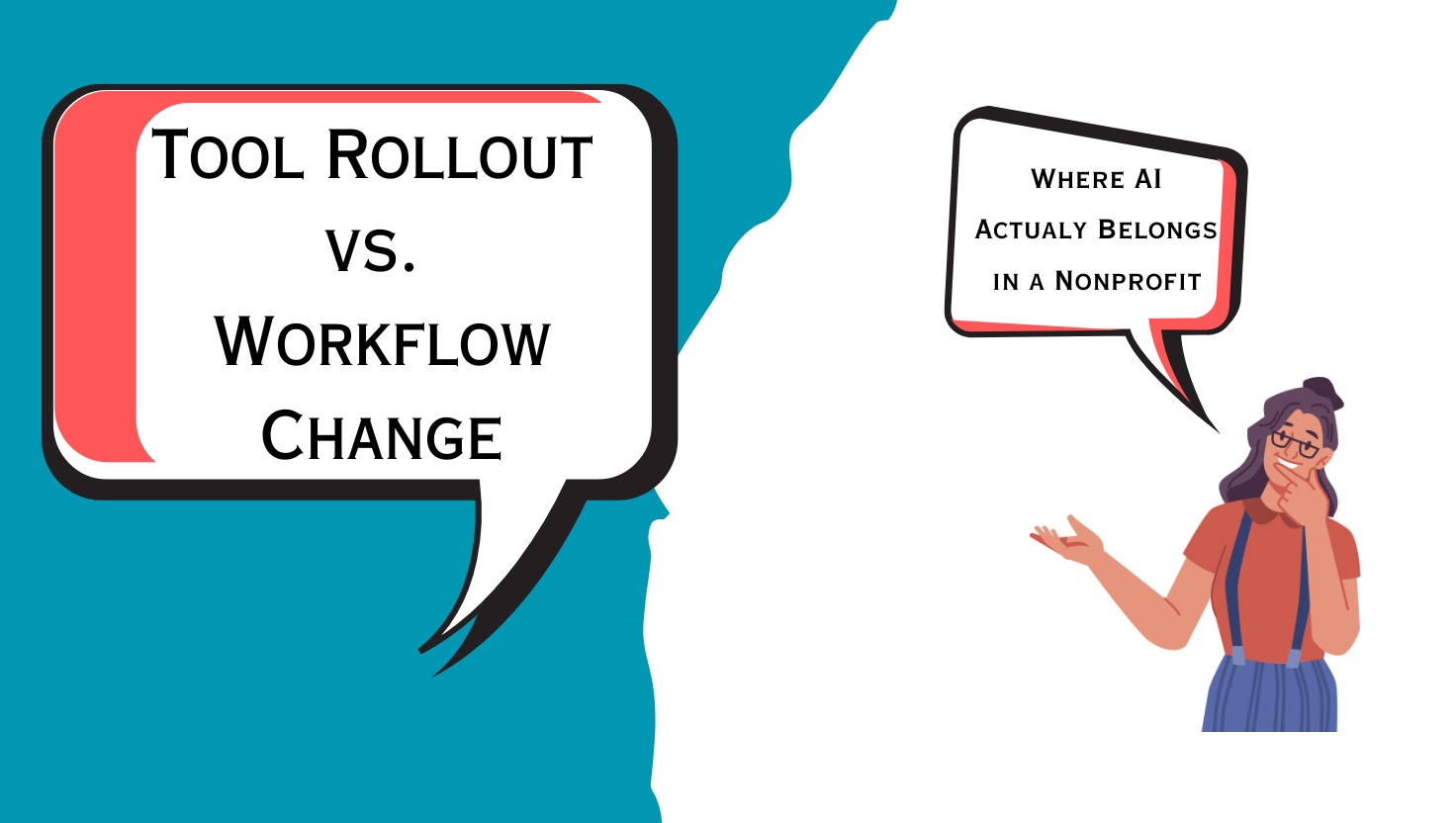
I used to talk about AI adoption the way most of the sector still does, as a project. Something you plan, budget for, roll out, and train people on. A capital-P Project with a start date and a launch.
Framing it that way makes it feel enormous, and it puts it permanently at the bottom of the list, behind everything a stretched nonprofit is already carrying. Worse, it aims the whole effort at the tool instead of the work.
The version I saw actually take root looked nothing like a rollout. It looked like one person changing one small part of how a single task flows through her week, because she could name the part that hurt. That is a much smaller thing to ask of a team, and it is a far more durable way to change how an organization works. Small workflow changes that one person makes and keeps tend to outlast big rollouts that were decided in a room those people never sat in.
How to find your own version of this
If you want to find where AI belongs in your organization, you do not need a strategy offsite. You need to go looking for the copy-paste.
Ask the people doing the work two questions. First, what is the part of your week you do by hand every single time, the same way, that never really needs your judgment? Second, if you could hand that part to a capable assistant and just describe what you wanted, what would you say to them? The answers to those two questions are your roadmap. Every one of them points at a small, specific, low-risk place to start, and none of them require anyone on your team to become technical.
That is exactly what an audit is, when you strip away the jargon. It is a structured version of those two questions, asked across the organization, with the answers turned into a short, prioritized list of places where a few hours a week are quietly disappearing and could be given back to the mission.
Want a map of how the work moves across your organization?
Book a free call about an AI Strategy Audit.
Book a free 30-minute call