The Year-End Appeal That Doesn't Treat Every Donor the Same
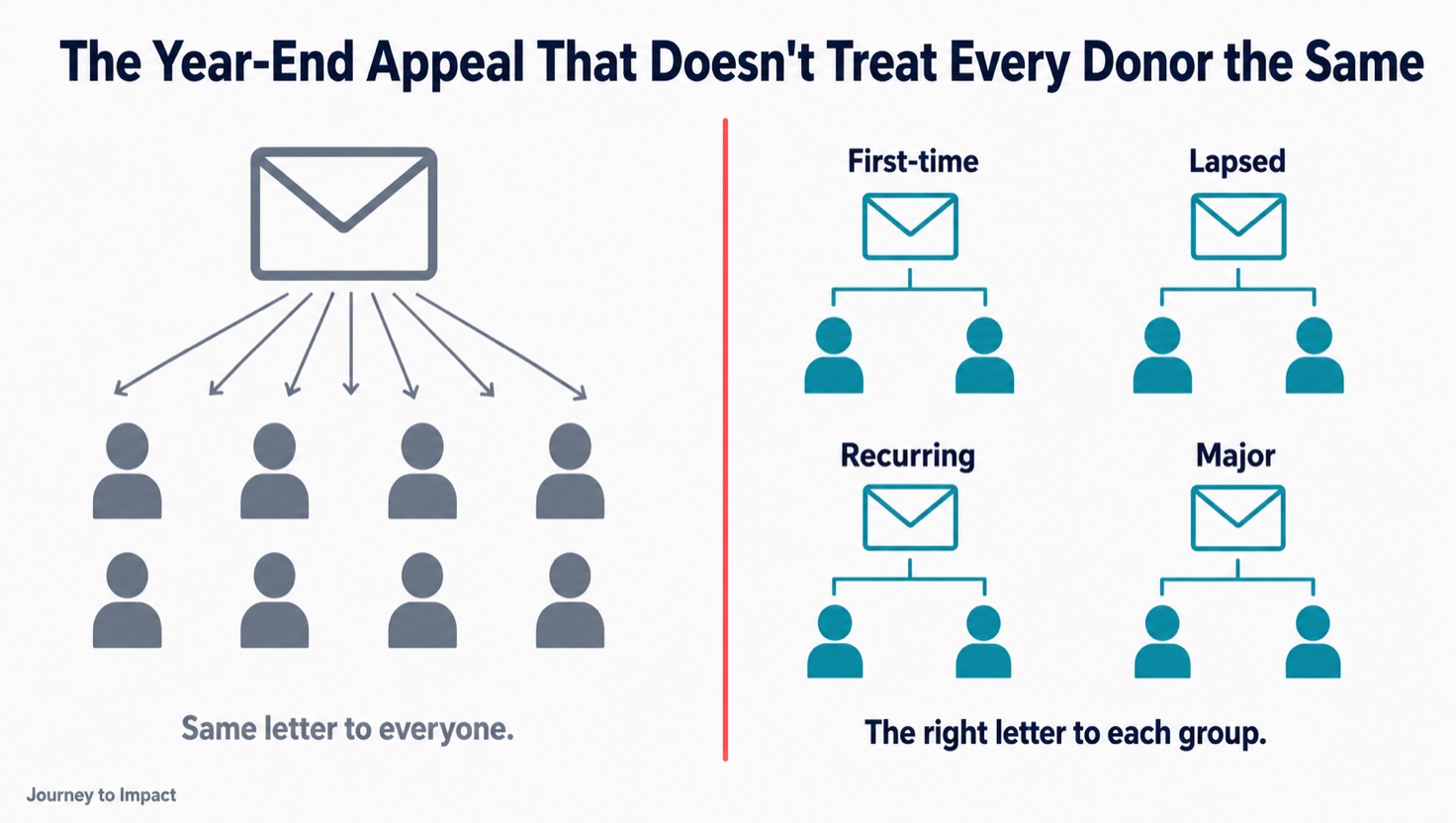
Every fall, nonprofits write one year-end letter and send it to everyone. The first-time $25 donor and the nine-year, $5,000-every-December donor open the same envelope and read the same words. It happens at organizations run by smart, dedicated people who know segmentation matters. It keeps happening because the work of segmenting a list by hand, and then writing a different appeal for each group, is a week nobody on a small team can spare in November.
I run donor management and fundraising operations every day. I have watched this exact thing more times than I can count. So here is the part worth your attention: the two jobs that made real segmentation feel impossible, the sorting and the drafting, are now an afternoon of work.
Here is the workflow I would run in July, step by step, so your year-end appeal is done and thoughtful long before the December rush.
Step 1: Pull your list with real giving history
Export your donor list from your CRM with the last two to three years of giving attached: name, total given per year, first gift date, last gift date, and gift frequency. If all you can get is who gave, how much, and when, that is enough to start. Keep the file on your own machine and strip out anything sensitive you will not use.
Step 2: Let AI sort donors into groups
Hand the file to your AI tool and ask it to group donors by behavior, not by gift size alone. You are looking for four or five buckets: first-time givers, lapsed donors, steady recurring supporters, mid-level donors ready to move up, and major donors. Here is a prompt you can paste in and adjust:
Attached is a donor export with giving history. Group these donors into 4 to 5 segments based on giving behavior (for example: first-time givers in the last year, lapsed donors who gave before and stopped, steady recurring donors, mid-level donors trending upward, and major donors). For each segment, tell me how many donors are in it, the traits that define it, and one sentence on what that group most needs to hear in a year-end appeal. Do not invent data. If a field is missing, say so.
Review the groups it gives you and move the edges around. You know your people.
Step 3: Name the one thing each group needs to hear
This is the strategy, and it stays yours. A first-time giver needs a warm welcome and a reason to give again. A lapsed donor needs to be missed, without guilt. A steady supporter needs to hear they are the reason the work happens. A major donor needs a specific, confident, bigger ask. One sentence per group is all you need.
Step 4: Draft a version per segment, in your voice
Give the AI your best base appeal plus the one-sentence message for each group, and ask it to rewrite the base letter for each segment while keeping your voice and your story. You will get five drafts instead of one. They are a starting point, not a finished product.
Step 5: You edit for heart, then send
Read every version out loud. Fix the lines that sound too smooth. Verify every number and every program claim against your real records, because AI states wrong facts with total confidence, and your name is on the letter. Add the detail that makes it yours. Then send.
What this looks like in a real small shop
Picture a two-person development team at a mid-sized affiliate. Last year they sent one letter to 1,400 donors and raised what they always raise. This year they spend one Tuesday afternoon on steps one through four. By the end of it they have five tailored appeals: a welcome for 180 first-time givers, a genuine we-miss-you for 220 lapsed donors, a thank-you-and-here-is-what-is-next for their recurring base, an upgrade ask for 90 mid-level donors, and a personal, specific letter for their 30 major donors. Same team, same afternoon they would have spent wrestling one generic draft. Five messages that actually fit the people reading them.
The guardrails matter
AI does the sorting and the first drafts. You keep the relationship, the voice, and the facts. Never let it fabricate a donor’s history, and never let a generated number reach a donor unchecked. Segmentation done this way is respect at scale. It gives you the time to say something true and specific to each group instead of one flattened message to all of them.
Which hours would you give back to your mission first?
Book a free call and let's find them.
Book a free 30-minute call